In a restaurant's daily operations, everything that gets measured seems to be under control. Confirmed reservations, completed orders, average ticket size, table occupancy. Dashboards show clean, actionable numbers.
But there's a critical part of the business that rarely makes it into those reports: missed calls.
While teams focus on optimizing what happens inside their systems, there's a constant flow of potential customers who never convert into reservations or orders. Not because they didn't want to, but because no one picked up. The result is a form of revenue loss that remains almost entirely invisible.
Why It Matters: The Cost of What You Don't See
Every missed call is more than a missed interaction. It's revenue that was never captured.
Unlike an abandoned cart in e-commerce, which at least leaves a trace, a missed call disappears completely. There is no record of who called, what they wanted, or how much that interaction could have been worth. From a reporting perspective, it simply doesn't exist.
This creates a structural blind spot. Restaurants make decisions based on incomplete data, optimizing what they can see while a portion of their revenue leaks out before entering the system.
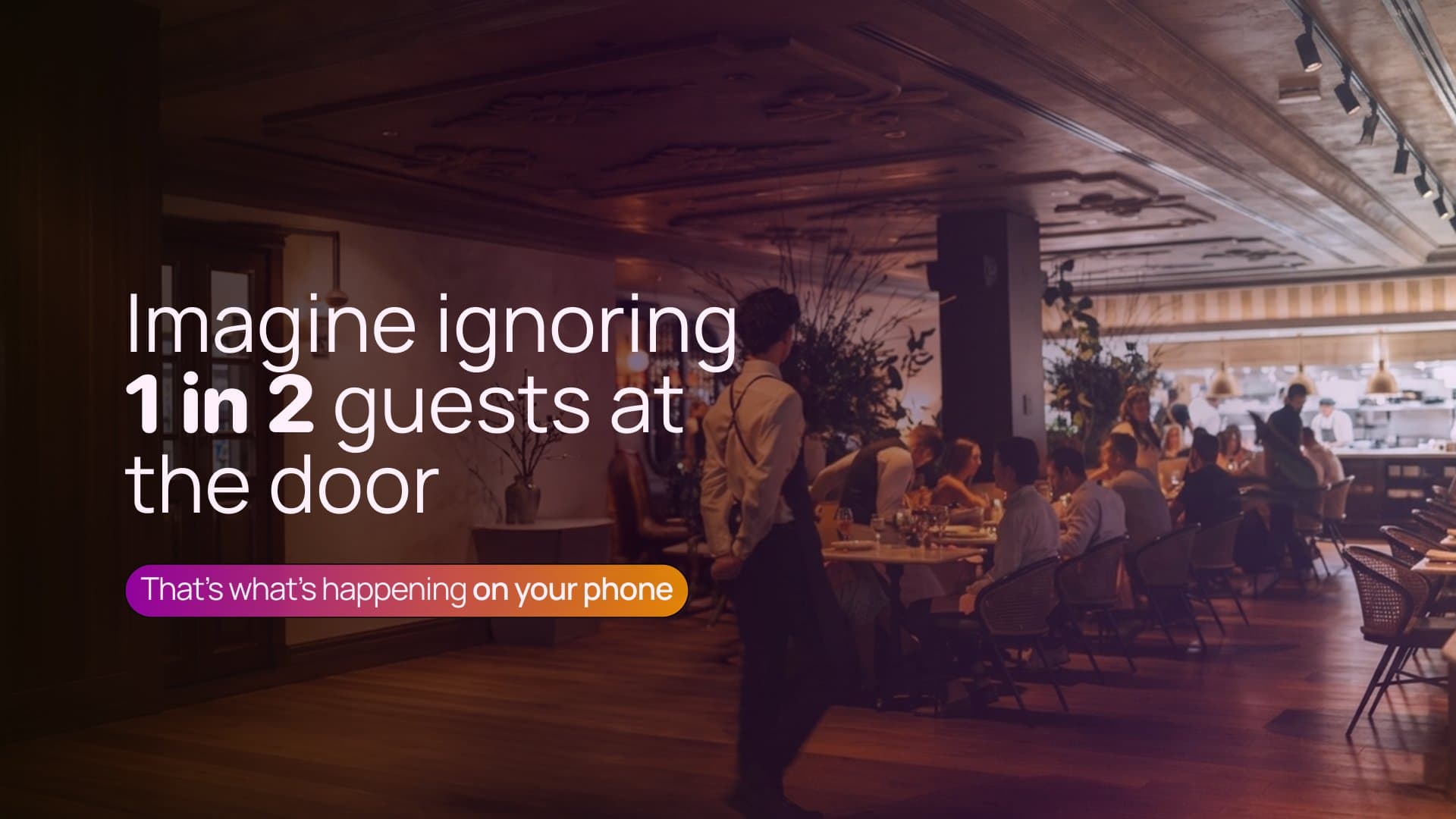
The scale of this blind spot is significant. Missed call rates can reach 30–40% during peak hours, meaning a large share of demand never even gets the chance to convert.
What Missed-Call Revenue Loss is NOT
Several assumptions tend to minimize the problem.
The idea that customers will call again rarely holds. Most don't, and 62% don't even leave a voicemail. The belief that online reservations replaced phone demand is also misleading. The phone remains a high-intent channel, especially for same-day decisions.
Call volume is often underestimated as well. Restaurants can receive between 400 and 3,500 calls per month depending on their size. And finally, this is not just an operational issue. It directly impacts revenue capture.
How It Looks in Practice
A customer calling a restaurant typically has high intent. They are ready to book, order, or decide.
The breakdown happens when the call goes unanswered, most often during peak hours or outside business hours. Customer patience is extremely limited. Many hang up within 20 to 30 seconds. After 30 seconds, abandonment increases sharply. After one minute, more than 80% of callers are gone.
They don't retry. They move on.
And critically, none of this is recorded. The interaction disappears, along with its potential revenue.
Key Metrics to Understand the Impact
To quantify this invisible loss, restaurants need to look at a different set of metrics.
Missed call rates often range between 30% and 40% in peak hours. Monthly call volume can go from a few hundred calls in smaller formats to several thousand in high-volume restaurants.
When calls are answered, conversion rates are strong. Reservations convert around 40–55%, while takeout can reach 50–70%. Average tickets range from $35 for simple orders to over $150 for reservations, with significantly higher values for large parties.
When combined, these variables show that each missed call can represent between $50 and $150 in lost revenue. On a monthly basis, a single location can lose around $7,200.
Most importantly, between 70% and 85% of that revenue never appears in any system.
The Restaurant-Specific Angle: Why This Problem Is Unique
Restaurants operate in a time-sensitive environment where demand is concentrated and decisions happen quickly.
There are no recovery loops. No retargeting, no follow-ups, no second chances. A missed call is usually the end of the journey.
That's what makes this issue both critical and consistently overlooked.
Checklist: How to Start Identifying Missed-Call Revenue
The first step is visibility. Restaurants need to understand what is currently invisible in their operations.
Start by tracking total incoming call volume and identifying how many of those calls go unanswered. Then, map when missed calls happen, especially during peak hours or outside business hours.
From there, estimate how many answered calls convert into reservations or orders, and define an average ticket value for those interactions. This allows you to calculate the potential revenue tied to each call.
Finally, compare that estimated revenue with what is actually reported. The gap between those two numbers is where missed-call losses exist, and where the opportunity lies.
Common Questions We Get
Why are missed calls important for restaurant revenue? Because they represent high-intent customers who are ready to take action. Losing them means losing revenue directly.
How much revenue can restaurants lose from missed calls? It depends on call volume, conversion rates, and ticket size, but estimates suggest around $7,000+ per month per location in many cases.
Why doesn't this revenue appear in reports? Because most restaurant systems only track completed transactions. Missed calls never enter the system, so they remain invisible.
How can restaurants start addressing this problem? By tracking call performance, identifying gaps in coverage, and implementing systems that ensure calls are consistently answered and converted.
Restaurants are highly optimized for what they can measure. But a meaningful part of demand happens before any system captures it.
Missed calls exist outside traditional reporting, which is why their impact is underestimated. Yet they represent some of the highest-intent interactions a restaurant can receive.
Understanding and quantifying this invisible revenue is the first step toward capturing it.
What goes untracked doesn't just go unnoticed. It compounds. And in the case of missed calls, it compounds into revenue that never even had the chance to exist.